
For some people, this topic is extremely flammable, but I’m not going to honor any nonsense here. There are three very important things to remember about nutrition, well, all things really.
- Moderation is the golden rule. Always remember this quote from Paracelsus (Swiss physician known as the father of toxicology): “All things are poisons, for there is nothing without poisonous qualities. It is only the dose which makes a thing poison.”
- If anyone is telling you that a whole class of foods should be avoided for dark and nefarious reasons, be wary of that person. They are trying to get you to join their cult and you will waste a lot of time and money figuring out that they are full of it.
- If anyone is telling you that your health and well-being are dependent on a specific supplement or supplements (other than your doctor of course) that are not readily available in edible food, they are lying to you. A lot of them get away with it because most people don’t know how to accurately sift through scientific literature or determine what should be considered legitimate studies. Bottom line, its mostly a lot of snake oil.
Here’s an example of some of the nonsense being grifted around and why its nonsense. These words are likely to summon some foaming at the mouth, rabid acolytes of this particular cult, but here goes: Seed Oils.
Seed oils are actually healthy when consumed in the recommended amounts. However, like ALL THINGS, they can be a problem when overconsumed. But that’s actually not the reason people freak out about them. The real reason is that a lot of processed foods often contain seed oils and as I’ve mentioned over and over again, a diet based mostly on processed foods is not the best and can lead to some health problems. I’ve pulled articles on this topic from PubMed for the past ten years and the only problem with seed oils is simply guilt by association. By cutting the amount of seed oils and the processed foods that contain them from their diet, many people are simply reducing the amount of fat they consume as well as reducing the amount of processed and fried foods in the diet. As a result, they feel better. That is pretty much all there is to say about seed oils.
So, let’s move on. What I really want to do here is to empower you to be able to cut through the nonsense and make some healthy changes in your life.
Knowledge is power and I find it is more important to understand WHY we take a certain approach to doing things than simply just knowing WHAT to do. Without the WHY, its hard to value the WHAT and it becomes very easy to be misled by the nutrition grifters. Your homework today is to empower yourself is to spend some time reading this primer on nutrition from my book Fitness without Fear. (Don’t be scared, its only 11 pages). This version is slightly longer than the passage in my book, but reading this will give you a very good understanding of nutrients, why diet is more important than exercise for fat loss, why we tend to overeat junk foods, and other really important things that not a lot of people talk about.
The best thing you can do for yourself going forward is to keep a diet journal. There are many apps we can download to our phones that are very easy to access and keep track of. If you struggle with estimating portion sizes, I would also recommend using a food scale to help with that. Be careful with setting a weight loss goal in these apps as I find they often underestimate how many calories we need in a day. Start with just tracking what you eat and then make small changes over time. I usually tell folks to start by making sure they are getting enough protein on a daily basis, 80-120 grams is a good initial target. From there, you can start tweaking your calories, fat, fiber, and sugar intake.
We haven’t changed that much since the end of the Ice Age, but our diets have. Our bodies are optimized for our ancestral diets that were based mostly on plants and wild game. Nowadays, the plants and animals we consume have been cultivated to be nutritionally different from those our ancestors consumed. Fruits and vegetables are higher in calories and lower in fiber and phytonutrients. Most farmed animals are not as healthy as their once wild counterparts and neither is their fat. Not to mention the fact that our ancestors ate every bit of the animal including organ meat and bone marrow where much of the vitamins and minerals are found whereas we tend to focus on the skeletal muscle. Our ancestors diets were also high in cholesterol and yet heart disease was simply not something that plagued them. Of course, they also got a lot more exercise, didn’t have sofas and Netflix, and ate way more fiber than all of us combined.
But fear not. In combination with daily moderate exercise, the Mediterranean diet and the Nordic diet have both been linked to longevity and good health. These diets are not just rich in lean protein sources and plants, they are also rich in locally farmed meat and produce. Not everyone has access to fresh meat and produce, but by paying attention to your food labels and choosing minimally processed foods (canned and frozen produce are just fine) can get you pretty close.
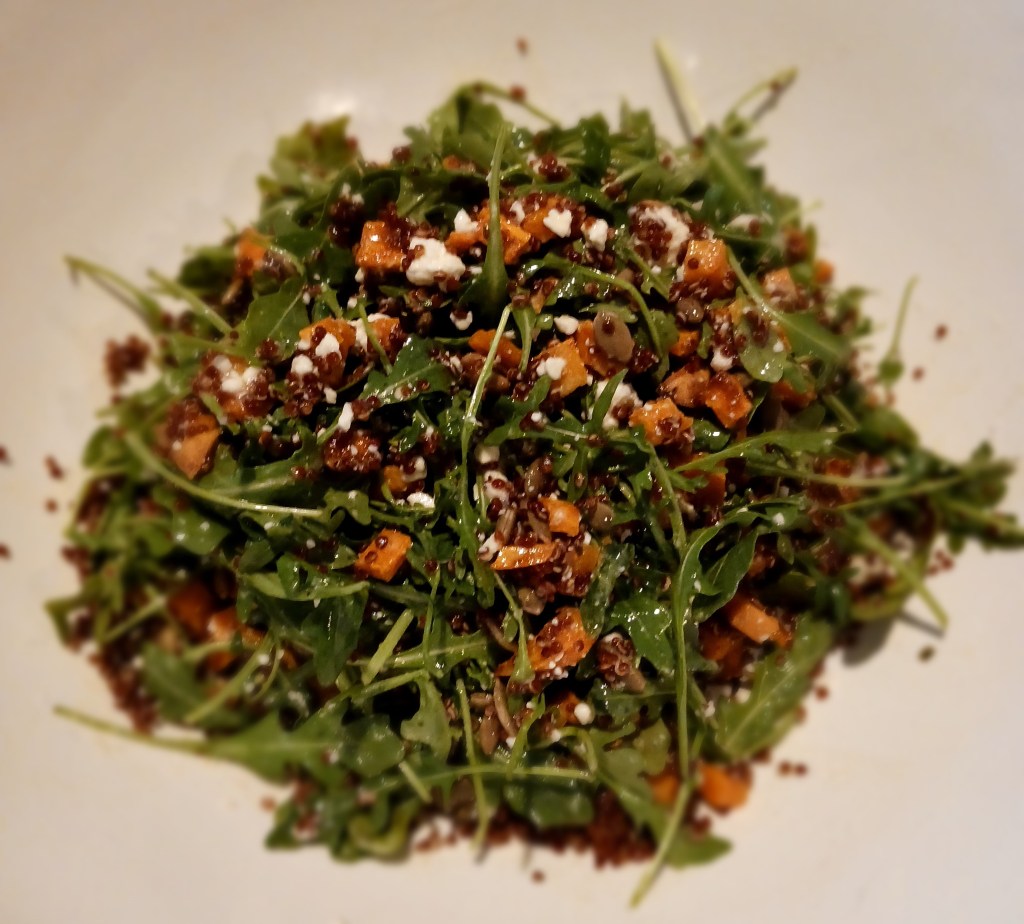
Just because I like you, here is a delicious, filling, filling high fiber recipe you can make in advance and add some protein to for a complete meal. Depending on your ingredients, you can make this for under $20.
Sweet potato, quinoa, and arugula salad
- 3 cups loosely packed arugula, kale, and/or spinach coarsely chopped
- 1-2 cups diced and roasted sweet potatoes (toss with olive oil and salt, roast at 400 degrees for 15-25 minutes until starting to brown)
- 1 cup cooked quinoa, couscous, or orzo
- 1/2 cup roasted pumpkin seeds or pistachios, roasted and salted
- 1/3 cup feta or goat cheese (optional)
Feel free to add in or substitute ingredients such as dried cranberries, olives, or chick peas. This is an extremely versatile dish and can be prepped in advance for work or school.
Dressing:
- Juice of one large lemon (about 3-4 tbsp)
- 1 tbsp sugar
- 1 tsp salt
- 1 tsp Dijon
- ½ cup olive or vegetable oil
Mix together all dry ingredients and then add just enough dressing to season everything. You can store extra dressing in the fridge for a few days.
 Be Strong, Be Kind